Doing More With Less: Modernizing Without Adding Headcount
Every hour spent manually reviewing CCTV footage is an hour not spent on inspection follow-up or maintenance planning. John Andros, senior director of customer enablement at SewerAI, breaks down what ROI actually looks like for contractors and municipalities, from a 50-truck rollout in two weeks to a city that went from a 15-year inspection cycle to a five-year one.
Executive summary
At most contracting firms and municipalities, too much staff time goes toward slow, manual tasks, when it could go toward the critical work that keeps infrastructure running. Every hour spent manually reviewing CCTV footage is an hour spent not on inspection follow-up, maintenance planning, or other priorities competing for a crew's attention.
"More work means more contracts, more hours billed, more footage inspected, and bigger checks," says John Andros, senior director of customer enablement for SewerAI. "This is especially true on the contractor side of things."
Large municipalities show the problem well. Their sewer departments often carry substantial headcount, but the staff is stretched thin: much of their time goes to repetitive manual review rather than higher-value work, so capacity gets consumed without the department actually gaining ground. Automating repetitive phases of the work changes the math. Staff can spend less time on manual review and more time on tasks that require judgment and expertise throughout the project.
The result: a more efficient workforce, and less pressure to solve capacity problems by adding headcount.
What this looks like for contractors
Andros recalls working with a contracting firm that needed to move quickly. They needed to get 50 TV trucks up and running as soon as possible to complete a municipal contract they had been awarded.
"They couldn't stop the work, and they were just awarded the contract," he explains. "They needed to prove to the municipality that it made the right choice going with them for the contract."
In order to keep the workflow steady, the contracting firm started working with SewerAI. That decision paid off, too. The company got the trucks up and running in just two weeks. Otherwise, it likely would have taken a few months to get the job done, stalling the workflow and missing critical deadlines for the municipality.
"We had a team that was locked in with these guys until they were done," Andros adds. "They spent all day, every day connecting with the field crews remotely and doing on-site installs."
The results are just as impactful for municipalities.
What this looks like for municipalities
In another instance, Andros recalls working with a municipality that aimed to inspect its entire system every five years. But at the current pace it was doing the work, it could only realistically be inspected every 15 years.
After changing how it managed and reviewed inspection data with SewerAI, the municipality got on pace to inspect its entire system every five years.
"By switching its contractors to Pioneer (SewerAI's cloud-based software platform that connects every stage of a water software program), running all of their inspection data through AutoCode (AI computer vision that automates the identification and classification of sewer defects) instead of manual review, they're right on target," he says. "That's really exciting for the entire city."
"Every resident in the surrounding area of that muni's service area may have had to go a decade without repairs, risk of overflow, and risk of system failure," Andros explains. "Now we've cut risk exposure down by more than 60%."
That kind of impact is easy to feel and hard to ignore, but it shows up in different ways across the water industry. That's why ROI is measured differently for contractors and municipalities.
What this means for contractors
On the contractor level, ROI is measured in time: how many hours were spent performing the work prior to using AI tools?
Andros was a contractor prior to his current role, and he was a SewerAI customer. After he started using AI tools at his previous company, he saw a significant change in how he approached the work.
"We rolled out Pioneer, and then we didn't need all those QC guys doing the work because we were completing 10 times the number of inspections we could complete in one day," he says. "We rolled those guys into trucks, we moved into a new market, and we did more work."
For Andros, the real ROI in this scenario was the immediate unlock of capacity. The company didn't spend more money on overhead costs, and it generated more revenue by having people perform higher-value tasks.
SewerAI improves how quickly inspections get done. But that 10x capacity gain raises an obvious question for operators: If AI is handling so much more footage, how much time does someone still have to spend reviewing what it produces?
Andros frames this question through a different lens.
Time spent reviewing CCTV video vs. reviewing AI output
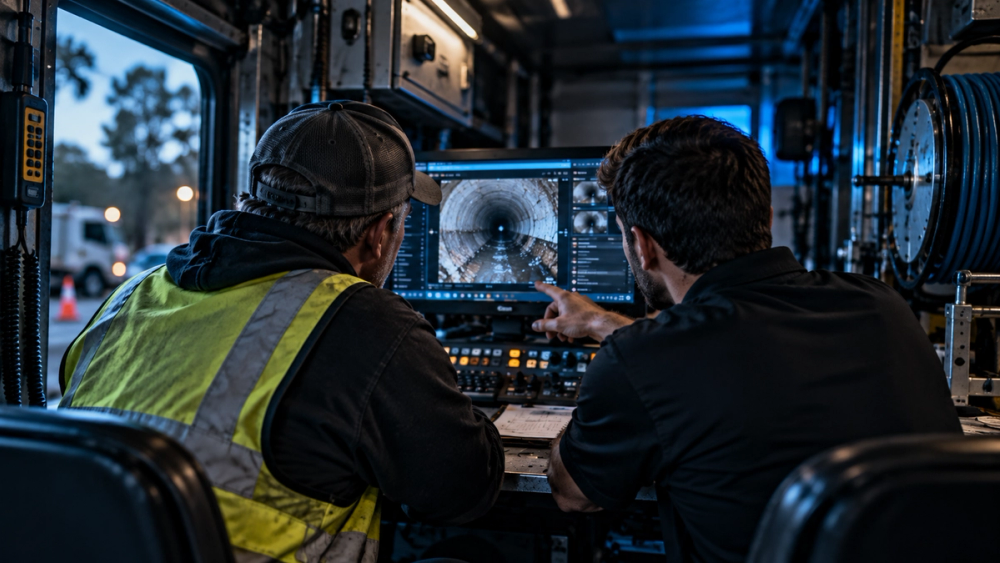
According to Andros, contractors and municipalities used to spend eight hours a day per team member reviewing CCTV footage. Now, some have cut that time in half, while others still spend the full day but review far more footage in it.
"Even if the guys and gals doing this work spend eight hours a day reviewing AI outputs, they're viewing 10 times more footage per session than they would without the AI-coded inspections," he explains. "With AI output, they just get the information they need and move on."
If operators were to compare how much time they spent watching 100 inspections end to end before and after they were AI coded, Andros says they would see a major difference. In fact, they could probably watch 200 more inspections in the same time span with AI tools.
"There's a lot of value now, especially when you've got a city that's under a consent decree or just trying to be responsible to its residents," he says. "Maybe they want to maintain their system every three years, or whatever their cycle is. We're empowering them to do that."
Human review remains an important part of the process. AI is designed to handle specific tasks at scale, while operators bring the context and judgment needed to interpret the results and make informed decisions.
"AI is going to be very specific about the task it's doing," Andros says. "A person can take other contextual things into account and recognize things that AI just can't."
A human still needs to review AI codes, and that probably won't change any time soon. That's why SewerAI is focused on reducing the amount of time the QC reviewer spends looking at AI output so they can be more productive on the job.
What this means for municipalities
Risk reduction is more of a concern on the municipality side: no consent decree, no fines due to an overflow from blockage or a system failure, and no state regulators stepping in.
"Municipalities don't want to spend a lot of money because they have to be reactive," Andros says. "With AI tools, they can be proactive because the speed at which it could perform is much faster than it was before."
There are two tools in particular that make that proactive, fast workflow possible:
- Risk and Rehab: A capital planning platform that turns existing CCTV data into instant, defensible capital plans.
- Command Center: An AI assistant that turns Pioneer data into answers, reports, and maps.
Andros summarizes ROI for contractors and municipalities succinctly: "On the contractor side, the ROI is the ability to do more work. On the municipality side, ROI is the ability to prevent unknown costs and expenditures while being able to better predict how your system will behave and what your costs will be."
Unexpected costs throw a wrench into rehabilitation plans, and there are more out there than one might expect.
Most municipalities know the risks of not modernizing their water infrastructure on a high level. However, they're probably unaware of what that risk means on a detailed level.
"They might know they'll have to spend tens of thousands or hundreds of thousands of dollars to fix the problem," Andros says. "But with Command Center and Risk and Rehab, they can actually get the real numbers."
These numbers are based on real data: historical events that have happened, real-world labor costs, material costs, and known fines for particular things. When a project manager uses Risk and Rehab and Command Center, they can easily find their highest-risk assets and find out how much it would cost to proactively make repairs and how much it would cost to not act at all.
Then, teams can generate reports showing the estimated cost to replace each asset. "Those are things that they don't always know and we help surface for them," he adds.
Beyond the cost of inaction, there's a second unexpected cost municipalities and contractors rarely budget for: turnover.
"There aren't any fees outside of the initial cost to adopt the platform," Andros says. "Everybody gets unlimited training, so we actually help you save on training costs. We also help with turnover."
When a new operator joins the team due to turnover, they can get up to speed relatively quickly with SewerAI's training tools.
"Let's say your principal operator for your TV team left and their replacement is still figuring things out," he explains. "You need to keep inspecting, so what do you do? With SewerAI, you can reach out to your technical account manager."
In many cases, municipalities and contractors fail to consider the underlying costs of turnover and training. Getting only one operator up to speed is expensive, let alone an entire team.
"You invest a lot of money in getting these guys trained up, getting certified, and then they leave," Andros says. "That's a sunk cost. We can certainly help mitigate that on some level."
Reducing the impact of turnover is especially important for small municipalities and contractors.
Enabling teams of all sizes
That kind of support pays off for smaller teams. Andros is especially fond of working with them. Within a week of working with SewerAI, he says, they should expect to see results and take action on what they're focusing on in their program.
This is directly in line with the customer enablement team's mission: to make contractors and municipalities super human, no matter how big their operation is.
"The team's function is to make our customers successful, productive, and to get them the outcome they purchased the product for," Andros explains. "Whether that means getting them set up and installed in their trucks or getting their back office team dialed in with all their tools, we're here to support."
This goes beyond phone calls and Zoom meetings. While these are helpful tools, Andros says, nothing beats meeting with customers in person.
"We have a dedicated team on the enablement side, and we travel all over the country to meet with customers who are struggling with their product or with a program," he explains. "There's just no replacement for sitting in a TV truck with a crew or sitting in the office with your GIS guy going over maps."
What doing more with less actually looks like
Across every example, the 50 TV truck rollout, the municipality catching up on years of deferred inspections, the QC team redeployed into trucks, and the small cities getting ahead of their capital plans, the throughline is the same. AI doesn't replace expertise that contracting firms and municipalities already have; it clears away the manual work that was keeping that expertise from being used where it matters most.
That's the real answer to the headcount question. Growth doesn't always mean adding people to do more of the same work. It can mean giving the people already on staff the tools to do 10 times as much of the work that counts while keeping humans in the loop to detect what AI can't.
For contractors, that shows up as capacity: more inspections, more markets, and more revenue without more overhead. For municipalities, it shows up as certainty: knowing the real cost of a failing asset before it fails, and having a plan instead of a reaction. Either way, the math changes. Instead of stretching the same staff even further, teams of any size can do more with what they already have.


STAY AHEAD OF THE FLOW
Get SewerAI updates, product news, and practical guidance for modern sewer inspection programs.