"We just pop the lid and look."
The math on manhole inspection just changed. Here's what that means for utilities, contractors, and engineering firms.
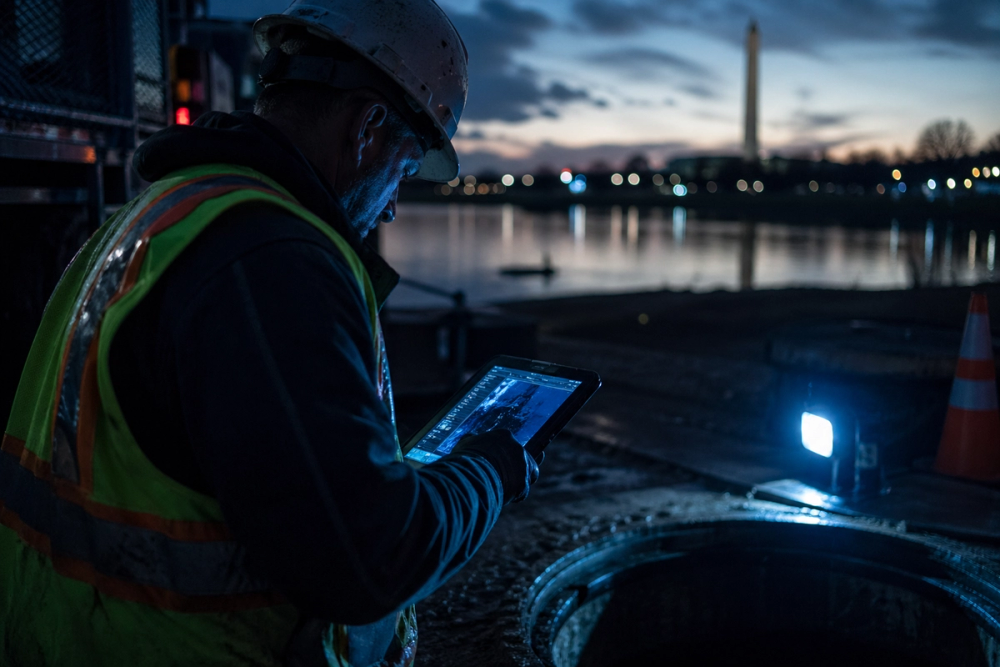
We’ve heard versions of that sentence from collections managers in seven states. Every one of them is a professional doing serious work on aging infrastructure with the tools the industry made available.
The senior engineer running sanitary sewer for a Virginia city told us his manhole condition assessment is “very elementary.” Pulling lids. Looking down. A collections manager in a Midwestern city of 90,000 has had manholes on the back burner for years; the pipe program is doing the heaviest lifting on root intrusion and I&I, and that’s where the team focuses. A New Jersey authority has spent two decades GPS’ing more than 7,700 manholes. They know exactly where every one is. The visibility inside them is a different question. “We have no idea what’s going on underneath the manhole cover,” the manager told us, naming a constraint the whole industry shares. They suspect I&I in the tidal areas along the river is significant. Without inspection-grade data, suspicion is the only available frame.
A South Bend utility manager told us his city ran a real manhole inspection program until about 2008. Then it stopped, and the institutional memory of why faded. He took over the department years later. “I wasn’t manager at that time. Whatever decisions they made before that, I don’t know.”
The pattern is consistent enough to be a structural feature of the industry. Every utility runs a CCTV program for its pipe. Almost none runs an equivalent program for its structures. The reasons people give for that asymmetry are scattered: not enough crew, the pipe program is the heavier I&I lift, “engineering handles that.” But underneath every one of those reasons is the same thing.
It was never about the operators. It was about the math.
And the math just changed.
The pipe got a program. The structure got a flashlight.
For a generation, mainline CCTV was the only inspection that pencilled. A truck-mounted crawler with a camera system represents real capital, but it’s recoverable capital: you charge by the foot, you bill the utility, you amortize the rig over thousands of segments. The economics work because pipe is long and inspection happens at scale.
Manholes are the opposite. Each one is a discrete asset. The legacy options for inspecting them at NASSCO MACP Level 2 looked like this:
A specialty manhole scanning camera ran $25,000 to over $100,000 for a single piece of equipment. Most cities didn’t buy them.
The alternative was confined-space entry. That’s a permit, two trained operators, fall-arrest harnesses, atmospheric monitoring, and a job that ran an hour or two per manhole if it ran clean. Most cities reserved confined-space entry for known repair situations, not for routine inspection. As one collections manager in Indiana told us: “We probably do between 150 and 250 confined spaces a year. If we see issues, we go down and fix them.” Inspection wasn’t the trigger. Visible failure was.
So manhole programs got built around the cheapest available substitute. Pop the lid. Shine a flashlight. If the operator says it’s bad, fix it. If not, move on. Repeat on a loose rotation.
Given the available economics, that was the responsible call. It was a program built to the budget, run by people who understood what they were missing but couldn’t justify the line item to capture it.
What the missing inspection costs.
The cost of operating without manhole-condition data shows up in three places that operators know well.
The first is inflow and infiltration. EPA puts I&I at roughly half of all flow into a typical wastewater treatment plant. Not all of that comes from manholes. Some comes from cracked pipe, leaky joints, illegal connections, broken laterals. But manholes are a disproportionate contributor, especially in tidal zones, areas with seasonal high groundwater, and any system where the structures are old enough to have brick courses that have been mortar-failed for decades. The New Jersey collections manager who’d GPS’d 7,700 of them named that exact concern: river-adjacent, tidal, and as he put it, “I&I could be through the roof. We have no idea.”
The second is reactive replacement. A public works director in a Texas border city told us his emergency budget gets eaten by manhole collapses every year. They replace two or three a year as failures. Some come in at $60,000. Some run to $100,000. He framed the math the way every public works director eventually frames it: “If we had something like your software, all we’d have to do is prevent one of those.”
The third is regulatory exposure. SSO consent decrees come with specific compliance pathways and deadlines, and a growing number of them include MACP-compliant manhole condition assessment as a named requirement. The City of Houston’s consent decree, for example, requires complete condition assessment of mains and manholes within fifteen years of the effective date, against MACP. A program that quietly hasn’t been inspecting structures for a decade is a program that, at year ten, has either built a parallel manhole assessment workstream from scratch under deadline pressure, or it hasn’t, and the penalties have started to compound.
These three costs share a shape. They’re invisible until they aren’t. And then they’re enormous.
The economics broke.
The hardware barrier collapsed about three years ago, and the industry is now in the early years of building around what that opens up.
The new manhole inspection workflow, in its entirety, is: a 360-degree action camera, a calibration board, an LED light, a worker at the surface, and a 30 to 90-second drop into the manhole. The video uploads to a platform that runs photogrammetry on the imagery, generates a 3D model and an unfolded flat view of the structure, and produces a NASSCO MACP-compliant condition assessment.
That’s it. No confined-space entry. No specialty rig. No certified manhole-inspection crew that didn’t already exist on the team.
In April 2024, we presented findings at WEF Collections from a head-to-head study comparing photogrammetry-based MACP assessment via Sewer3D against traditional MACP inspection. The summary version: defect detection accuracy is highly comparable to traditional methods, project cost per manhole comes in at a fraction of legacy methods, and the photogrammetry workflow produces a persistent 3D digital twin that traditional inspection can’t easily replicate. The full study is publicly available on our resources page.
Here’s what that has produced in adoption terms. Sewer3D customers have run over a quarter million manholes through the platform to date. About half of those came in the last twelve months alone, up roughly 35% year over year. The average program puts about 860 manholes through the platform in twelve months. The largest programs are well into the thousands.
And here’s the pattern that matters most: roughly four out of every ten Sewer3D customers used the product to launch a manhole inspection program for the first time. They didn’t have an MACP cycle before.
The customers who came to us with no manhole program were not, in our experience, smaller or less professional than those with one. A 2,400-mile system in Wisconsin had its structures siloed to engineering and out of the operations cycle. A 90,000-resident city in Indiana had decided, rationally, that televising every line had to come first; roots were the bigger I&I lift. These were the right calls under the constraints. Manhole inspection wasn’t a sophistication problem. It was an economics problem.
The economics are different now. The constraint that ran the playbook is gone.
What a complete inspection program looks like now.
A complete collection-system inspection program now includes structures, on the same operational cadence and at comparable cost-per-asset to mainline CCTV. That’s new. For most of the industry’s history it wasn’t an option. It is now.
What this looks like, practically, for the three audiences who manage collection systems:
For utilities running inspections in-house, the move is to stand up a manhole capture cycle on the same operational rhythm as the CCTV cycle. Same crews, different tool, comparable cost-per-asset. The data flows into the same platform and the same risk model that already prioritizes pipe defects. One Indiana utility customer who’d been pulling lids for years described the shift to a real MACP cycle as taking an inspection that used to consume an hour or two of header paperwork and reducing it to about two minutes of assessment time per manhole.
For contractors, the same hardware unlocks a new service line. Working contractors are pricing manhole-with-AI bundles 20 to 25 percent above standard CCTV and finding that customers pay it, because the deliverable (a 3D digital twin, NASSCO-compliant coding, persistent reviewable record) is qualitatively different from the deliverable a $300 photo log produced. The contractor world is not getting disintermediated by this. It’s getting upgraded.
For engineering firms scoping rehab and capital projects, the manhole program changes what you can pencil. A defensible Level 2 condition assessment across an entire manhole inventory replaces extrapolation from samples. That changes how cost estimates get built, how rehab programs get sequenced, and how capital plans get defended in front of councils that have started asking harder questions about which assets actually need the money.
The economics that built the inspection-program asymmetry are gone. The picture is finally buildable at the same operational rhythm as the CCTV program, by the same teams, on the same risk model. The utilities, contractors, and engineering firms that have moved on this are doing the kind of work the industry has wanted to do for decades. The rest of the industry will get there, on the timeline that fits each program. We’ll be here for it.
Knowing what’s underneath your manhole covers is no longer a $200,000 question.
If you want to see how that plays out in the field, Jamie Truax (Truax Corporation), Kevin Marsh (Trekk), and Samantha Pierce and Eric Sullivan from our team are walking through it on May 20 at 10 AM PT. They’ll cover how Truax is completing 100+ manhole inspections a day with the crew they already had, how better cameras and AI change the math on bidding manhole work, and the parts of the rollout that didn’t go smoothly.

STAY AHEAD OF THE FLOW
Get SewerAI updates, product news, and practical guidance for modern sewer inspection programs.