The AI Revolution Under Our Feet: A New Era for Infrastructure's Unsung Heroes
Many people may not know that during COVID-19, CISA classified water and wastewater workers alongside healthcare workers as Essential Workers. For too long, the technology available to them hasn't matched the importance of what they do. Until now.
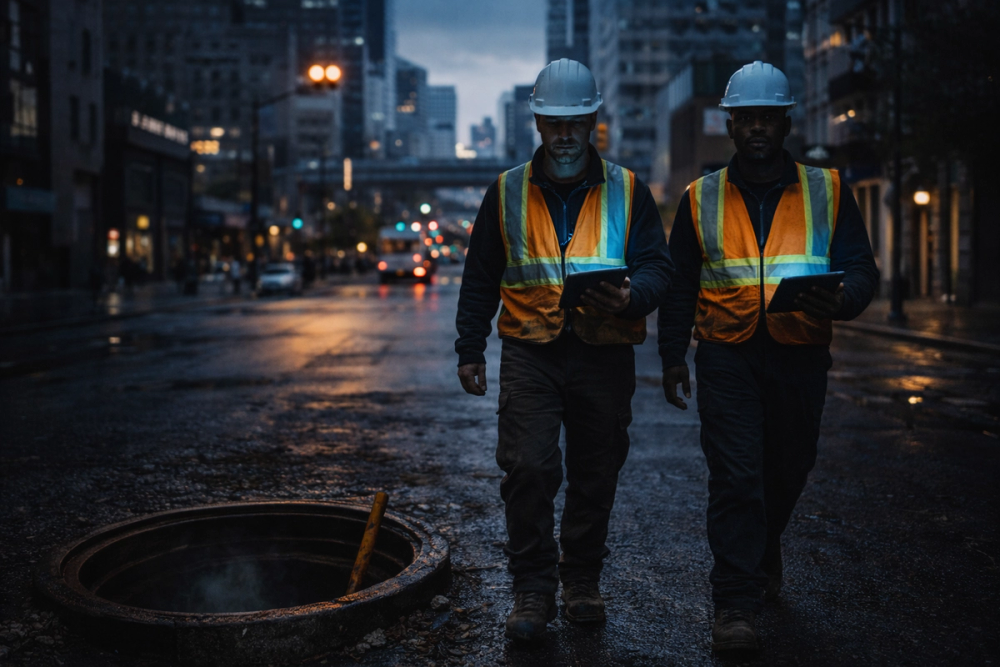
The AI Revolution Under Our Feet: A New Era for Infrastructure's Unsung Heroes
Many people may not know that during COVID-19, CISA classified water and wastewater workers alongside healthcare workers as Essential Workers. For too long, the technology available to them hasn't matched the importance of what they do. Until now.
By Abhinoor Dhull, SewerAI
Many people may not know that during COVID-19, CISA — The U.S. Department of Homeland Security’s Cybersecurity & Infrastructure Security Agency — classified water and wastewater workers alongside healthcare workers as Essential Workers. It makes sense — without functioning sewer and water systems, hospitals can’t operate, and entire communities face public health emergencies. But, even today, many of them are still operating with tools that haven’t fundamentally changed in decades: manual CCTV review, spreadsheet-based tracking, desktop software that predates the smartphone. These are the unsung heroes who keep this critical infrastructure running — and for too long, the technology available to them hasn’t matched the importance of what they do. Until now.
The Equation Has Changed
The ASCE Infrastructure Report Card continues to give wastewater a D+, with a $69 billion annual funding gap in 2025 projected to reach $690 billion by 2044. Collection system failures have risen from 2 to 3.3 per 100 miles of pipe over the last decade. And 30% to 50% of the water workforce will be eligible to retire within the next decade, taking decades of institutional knowledge with them.
The operational reality is clear: we need to inspect, assess, and maintain more infrastructure with fewer people, tighter budgets, and — until recently — the same tools their teams were using fifteen years ago. Technology and AI revolution is the most credible path to closing that gap.
From Talking about AI To Leaping Forward with it
The infrastructure sector has heard technology promises before. What distinguishes this moment is the quality of evidence behind it.
Computer vision for pipe inspection is now achieving accuracy in the 95%+ range across real-world deployments — thousands of miles annually, not controlled test environments. When Houston Public Works deployed AI-powered workflows across their 6,000 miles of pipe and 133,000 manholes, the results were concrete: a 55% reduction in contractor data failures and over $1 million in cumulative savings, all while meeting aggressive EPA consent decree timelines.
These outcomes are consistent with broader research on AI-augmented work. A Harvard Business School and BCG study found that professionals using AI completed tasks 25% faster and produced results over 40% higher in quality — with the largest gains going to workers who had the most ground to cover, improving their output by 43%.
The Human At The Center
The most effective AI deployments in infrastructure share a common design principle: AI handles the volume, and experienced professionals handle the judgment. The operator still runs the truck. The engineer still determines what gets rehabbed and when. The asset manager still balances risk against budget.
What changes is the support structure around them. Field crews inspect pipes in half the time and make submissions in a day or two — no more backlogs stretching months while footage sits in a queue. Engineers work from consistently coded data rather than subjective assessments that vary reviewer to reviewer. Managers can extend the reach of their existing teams without waiting for a headcount that, in this labor market, may never come.
The Window Is Open.
The proof-of-concept phase is over. The technology is ready, the workforce constraints are accelerating, and the cost of inaction compounds every year the backlog grows and experienced staff retire. After processing more than half a billion feet of underground pipes with AI across wildly different pipe materials, diameters, ages, and regional conditions, one lesson stands above the rest: the quality of the data going in determines the quality of the decisions coming out for risk and rehabilitation decisions.
The organizations that move now will set the standard for how this industry operates for the next decade. As a civil engineer myself, I have walked the field in my baggy overalls, and one thing is clear: the essential workers keeping communities safe deserve tools that match the scale and significance of what they’ve been asked to do. The technology is here and AI and cutting-edge technology can no longer be a side project but an operating requirement in infrastructure.
For more on the macro forces driving AI adoption in infrastructure, read my piece in Forbes.
Abhinoor Dhull is the VP of Operations of SewerAI, the #1 platform for underground infrastructure management. SewerAI's Pioneer platform has processed more than 100 million feet of pipe video across 2,000+ cities nationwide.
STAY AHEAD OF THE FLOW
Get SewerAI updates, product news, and practical guidance for modern sewer inspection programs.