The Most Expensive Line Item Is the One You Didn't Spend
Most U.S. water infrastructure is decades past its prime. The fix isn't more money — it's better prioritization. Here's what proactive infrastructure management really costs (and saves).

This post summarizes key findings from our latest whitepaper. Download the full whitepaper here.
Executive Summary
Most U.S. water infrastructure is decades past its prime, but utilities can't replace pipes on their own timeline. They have to work with the budget they have, not the budget they need. But the real fix isn't more money, it's better prioritization, weighing the likelihood that a pipe will fail and the consequences if it does.
Houston’s experience with SewerAI shows what that looks like in practice: AutoCode and Pioneer helped the city save more than $1 million and cut the labor hours needed to review data. The upside only compounds from there; fixing a pipe before it breaks is four to five times more cost-effective than an emergency repair, and cities don’t need perfect data or a big budget to get started. Proactive infrastructure management doesn’t just prevent the next crisis, it’s the cheapest line item a utility never has to write.
The Reactive Trap
In most cases, being proactive about water infrastructure isn’t an option for utilities. That’s why many wait to act until they’re backed into a corner when a water main break occurs or a pipe collapses.
Using existing pipes for as long as they can is commonplace for utilities. That’s why most water infrastructure in the U.S. is 60 years out of date.
“The best case scenario would be to replace your pipes every year, but that’s not realistic,” explains Matt Rosenthal, co-founder of SewerAI. “The second best scenario would be replacing a pipe the day before it breaks. If we could do that, I should probably be playing the lottery.”
Neither of these scenarios is feasible. Utilities work with the budget they have, not the budget they need. This means the fix isn’t more money, it’s better prioritization. That’s where GIS tools come in.
But prioritization only gets you so far without weighing cost.
The Common Mistake
One of the most common mistakes utilities make in risk assessment is prioritizing assets based on condition alone. The most severe defect isn’t always the asset that carries the most risk.
“People will often look at a big issue and say that’s the first thing that needs fixing,” he explains. “However, they might already have data that indicates that something much more dramatic could be a problem very soon. So they aren’t taking into account every piece of information to properly assess risk.”
There are two critical factors that go into assessing risk:
- The likelihood a pipe is going to fail. Is the pipe cracked or degraded? This is typically easier to see.
- The consequence if the pipe does fail. Harder to gauge. A pipe’s video feed won’t tell you if it’s under a school, a hospital, or a sensitive waterway.
“Taking into account all those factors that you as a city want to prioritize is challenging,” he says. “Understanding all those different factors and putting them into your risk model is a challenge as well.”
Every city has different priorities, so what they decide to prioritize may be different from a neighboring city. This could range from environmental concerns to ecological sensitivity to the pipe’s location.
“A pipe might be close to the mayor’s house, so the city wants to be especially careful with it,” he says. “In our platform, cities can easily choose the parameters to decide which pipes they want to fix first.”
By adjusting these parameters to their goals, cities can better choose which projects to take on based on what they deem important. But more often than not, a city’s budget determines which project they can afford.
What Proactive Looks Like in Houston
Being proactive is the most effective way for utilities to lower risk and prevent pipe failures, and that ultimately comes down to lowering how much they’re spending to avoid failures. “Here’s the way I like to think about it: how can I drive down the number of emergencies and spend money as optimally as possible,” Rosenthal says.
For instance, if a city drives down repair costs by $2 million but spends an additional $1.5 million by taking proactive measures, it’s ultimately going to save money in the long run.
Putting that principle into practice looks different in every city, but Houston offers a clear example.
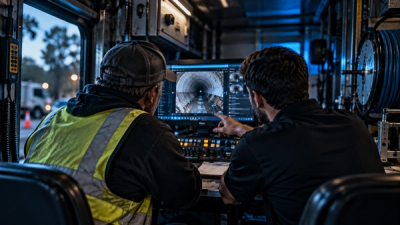
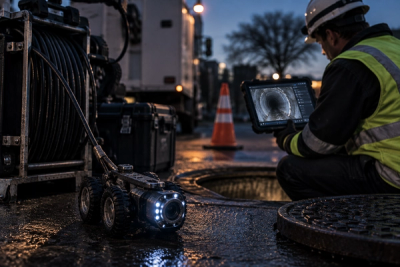
The city uses several SewerAI tools to modernize its collection system, including QAI for automated quality checks. Houston is also exploring 360-degree cameras for manhole inspections.
The QA/QC program has helped the city reduce the number of contractor data submittal failures while also yielding more than $1 million in savings for Houston.
“The data is readily available both in the app and via an API, making it easier for operations to make critical decisions required to maintain the collection system,” says Greg Eyerly, senior assistant director for Houston Public Works. “This system reduced the internal labor hours needed to code and review, and the data is more precise.”
This isn’t just the story for Houston. It’s the model for a country full of aging systems working with budgets that can’t keep up. That’s where AI assessment makes a real difference: optimizing capital planning decisions so city budgets are allocated more effectively.
A Closer Look at Macomb County
Macomb County, Michigan, is a prime example of how Pioneer and AutoCode can help with cost savings. Within 24 hours of using SewerAI’s platform, the county overhauled the results of a manual NASSCO assessment, keeping it from spending $1 million on non-emergency repairs.
Repairs that had been flagged as urgent during the manual assessment were misclassified. Additionally, AutoCode found significant defects that were missed during the original inspection. Macomb County would have missed these findings entirely if it had just accepted the first report and didn’t request a second inspection.
This reassessment emphasizes what’s at stake when a misinformed capital-planning decision is made. A city’s limited budget can be directed toward unnecessary repairs while higher-risk assets go unaddressed.
“Questioning some of the recommendations we received from a recent assessment project, we turned to SewerAI’s AutoCode to reassess the data,” says Vincent Astorino, operations director for Macomb County Public Works. “Their swift action not only saved us over a million dollars in repairs previously recommended as immediate, but it also uncovered critical defects within 24 hours of analysis—information missed in the original assessment. Working with SewerAI has been incredibly satisfying, and we’re eagerly anticipating future collaborations.”
If Every Utility Adopted Risk-Based Prioritization
If every utility adopted AI-driven condition assessment tomorrow, Rosenthal says, risk analyses would be run more effectively. In other words, cities would know which pipes they should be concerned about and which ones need to be fixed first.
“If they could get an optimal schedule for inspection, cleaning, and repair, they would focus on the most important assets,” he explains. “The downstream effect of that is their system would have fewer emergencies.”
If an infrastructure issue can be addressed before it becomes a bigger problem for a city, it’s significantly more cost-effective. In fact, fixing a pipe before it fails can cost four to five times less than repairing it after a failure.
“If you can do proactive repairs instead of emergency repairs, cities can save a ton of money,” Rosenthal says. “We ultimately drive down costs for ratepayers and reduce the number of closed beaches because we’re effectively managing these pipes before they overflow.”
After a pipe breaks, cities need to consider a pump bypass, emergency construction, and people working overnight and on weekends. Proactive risk management helps cities avoid all of these costs—and sometimes, those costs can hit seven figures.
The Barrier to Entry Is Lower Than You Think
For utilities that have never used AI before, SewerAI made getting started simple—all they really need to have is data that’s up to date.
“Our tools are user-friendly and don’t take long to set up,” Rosenthal says. “If you have your data, we can pull it into our system. All we need is the status of your pipes, some GIS maps that show where they are, and we can immediately give you a prioritized list.”
With this tool, utilities can get a full risk and rehab analysis in just a few minutes. Historically, this process would have been months long and cost cities hundreds of thousands of dollars. The more data a city has, the more accurate their analysis will be.
But what if a city has outdated or inaccurate data?
It’s not a dealbreaker. Rosenthal says the platform will work with whatever a city already has, and the analysis gets sharper as the gaps get filled in.
“The minute a pipe is auto-coded through our system, and that happens within minutes, the data is in our system immediately and the risk analysis will update instantly,” he explains. “We’re not doing a separate analysis, the data is just always updated in our system in real time.”
That also ties back to something Rosenthal mentioned earlier—the more data a city has, the more precise the prioritized list becomes. In other words, outdated data doesn’t mean that cities have to wait to start. It just means that round 1 is a baseline, not a final answer.
The Trust Barrier Is Lower Than You Think
For some utilities, the thought of collaborating with an AI company might sound daunting—to some, it may sound like a new concept entirely. But getting started is straightforward, and the risk assessment process only gets easier from there.
Above anything else, Rosenthal says cities and utilities get the most hung up on AI’s ability to accurately diagnose risk.
“Many folks think the system is more complicated than it really is,” he says. “The biggest misconception is that AI assessment is a black box.”
SewerAI users can use the platform’s chat-based interface to get quick answers to their questions—it’s also very easy to interact with, making the tool more of a sidekick than a mysterious “black box.”
“You could ask it for an explanation of every parameter for each asset, and it’ll make you an Excel table listing what the main factors are,” he explains. “It can even explain why it marked certain pipes as ‘high risk.’”
The goal isn’t to eliminate the jobs of general contractors and engineers—it’s to optimize the decisions they make every day. These include choosing which pipe to inspect first and how much money the city should be spending in the next one to five years.
Here’s an example of what a tedious task looks like with and without AI assessment: A data manager gets a new batch of inspection footage.
- Without AI assessment: The data manager spends hours manually reviewing video, cross-referencing pipe conditions and building a priority list by hand—the entire process takes a full day of work, and puts their other projects behind schedule.
- With AI assessment: The new footage gets auto-coded, risk-scored, and worked into a ranked priority list in just a few minutes. If their supervisor asks why a pipe is considered “high risk,” they can pull up the exact factors behind that score.
“The goal of our tools is to make that decision-making easier,” he says. “They’re there to make data managers and field technicians better at their jobs so they can make the best decisions possible—that leads to better outcomes and lower costs.”
Whether it’s Houston shaving hours off its QA/QC process, Macomb County avoiding a $1 million mistake in 24 hours, or a data manager getting an afternoon back to focus on other work, the pattern is the same: the biggest wins come from spending that never has to happen.
A pipe that’s fixed before it fails, a repair that’s never misclassified, or a crisis that never reaches a city council meeting. It doesn’t show up on a balance sheet, but it’s in every budget that isn’t spent on emergency construction and overnight repair crews. That’s the real return on investment for proactive infrastructure management. The most expensive line item isn’t the one utilities wrote a check out for, it’s the one they never had to write in the first place.

STAY AHEAD OF THE FLOW
Get SewerAI updates, product news, and practical guidance for modern sewer inspection programs.