From the Underground Up: Breaking Down SewerAI's Product Philosophy
SewerAI Principal Product Manager Seth Nickinson on why the company writes its roadmaps in pencil, how it keeps teams aligned, and what it means to build products that are 10x better — not 10% better.
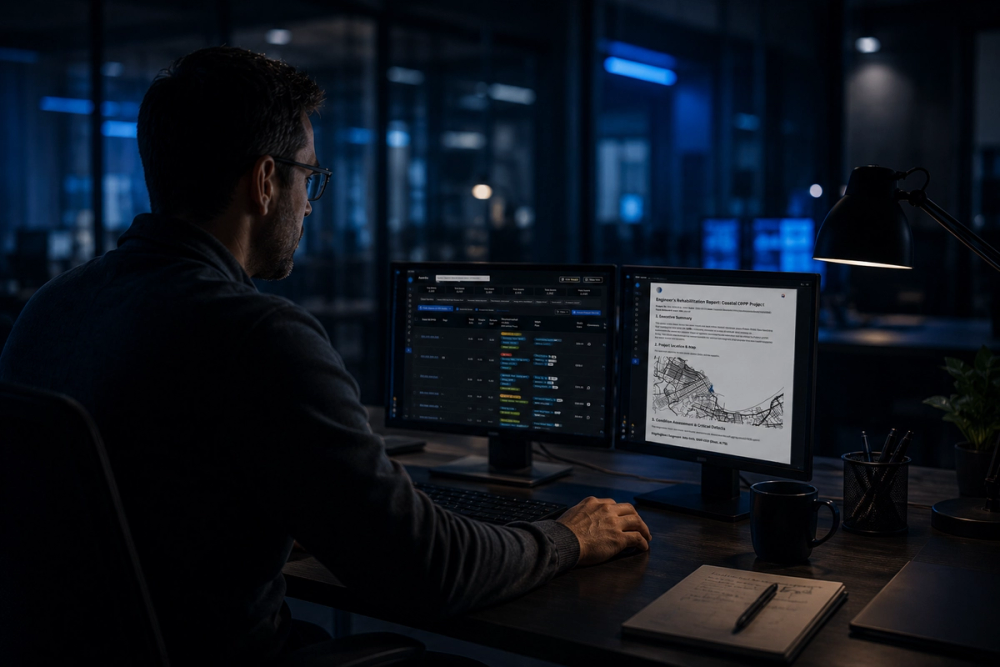
Download the full whitepaper: Breaking Down SewerAI’s Product Philosophy →
Executive Summary
SewerAI writes its marketing plans in pencil. Not because the team is indecisive, but because it knows better than to predict where AI will be in a year from now.
“Every product team knows there are more ideas than time and capacity,” says Seth Nickinson, Principal Product Manager for SewerAI. “We have cracked open an entire universe of cloud SaaS, computer vision, collaboration, hardware and software integrations, data analysis, and agentic tools for our vertical. So there are infinite feature requests and gaps we could fill.”
That same instinct shapes SewerAI’s approach to product development. The company doesn’t publish multi-year roadmaps and blindly execute against them. SewerAI has strong directional ideas of where it wants to be in the next three to six months, with a long-term vision in view but not locked in.
That direction shifts often, sometimes dramatically, as the underlying technology evolves. “We have the data, the connectors, the AI tools, and the cloud platform,” he says. “The job now is to bring it together so managing a sewer program feels radically easier for everyone involved. And then deploy that tech into every community in North America.”
The opportunity is to turn sewer program management from a fragmented, manual process into a collaborative, AI-powered workflow. Pulling that off requires the whole company to move together, which is why alignment isn’t an afterthought at SewerAI. It’s a discipline.
Keeping the team aligned
When SewerAI develops a new product for customers, every teammate has a seat at the table, from the leadership team to sales reps.
“For every project, we have a kickoff that includes executives and the engineers expected to work on it,” Nickinson says. “At those meetings, we present our discovery findings. What is the rationale for this product? Who is it meant to serve? What’s the business case? What evidence do we have? What are the main jobs to be done? Everyone is welcome to ask for clarifications or more research.”
The engineering team knows how quality products are built, the design team knows how interactions work with users, and the marketing team knows which message to send — the end user brings all of these teams together.
Beyond internal alignment, SewerAI also stays connected to the field, gauging how a product will land with customers before it’s fully built out. One way the company does this is by putting early betas out to customers to get feedback in real time.
Early customers can test out the new product before it goes to market. SewerAI has an experimentation system that allows it to easily turn on new features — it will simply give customers a heads up, then follow up with surveys or phone calls to see how it works for them.
When SewerAI gets mixed feedback about a product, it keeps it under wraps until it’s further developed. This process keeps the company from building a solution to a problem customers don’t actually face in their daily work.
“We have regular scheduled check-ins with our go-to-market colleagues, whether that’s sales or marketing,” Nickinson says. “We build fast and release fast, so we have to coordinate to make sure our entire staff and the market knows what we have built.”
But alignment only answers how SewerAI builds. It still has to decide what to build next.
Determining what goes to market and what gets shelved
While customer needs are SewerAI’s top priority, the company also considers what it wants to focus on next as a business.
“For us it’s a simple two-fold measurement. Do people use it, and do they love it?” Nickinson says.
“We know not all our products are going to be blockbusters used by 100% of accounts, like our AutoCode AI computer vision or our GIS maps,” Nickinson says. “We have several customer types. But we set realistic goals and benchmark off our other features and products. For instance, our Manhole product, called Sewer3D, isn’t used by everyone, but it has radically transformed how manhole inspections are done in our industry and has seen steady growth since it launched.”
The company uses internal metrics to determine which products it should prioritize first — this includes productivity, risk reduction, and value to customers.
Human judgment is essential in SewerAI’s product development process. Simply plugging data points into the formula will not produce a perfect product that garners zero customer complaints.
“We know if customers love a product based on qualitative feedback,” Nickinson says. “It includes not only current customers but Sales prospects in the pipeline. We have a live chat in our app. Our customers are very vocal. If they love something, we hear it. If they hate something, we hear that, too. So if the market reception is strong, we know quickly.”
But knowing what customers want is the easy part. Building it without dropping everything else is where the real tension lives.
Balancing new launches with existing priorities
The most difficult part of launching a new product for SewerAI is hearing back from customers and meeting them where they are. Utilities move at different paces — their planning and budgetary cycles differ for when they can replace assets.
SewerAI tries to be responsive before anything else, ensuring customers have the tools they need to solve problems that arise in their work.
The world doesn’t stop when SewerAI starts working on a new product. The company has other customers and features it must support on top of a new product launch.
Nickinson recalls a few product decisions the company made over the years, each shaped by a customer demand. Given how fast technology moves, he says, there is always an opportunity cost to shifting focus. But when demand is high enough, SewerAI adds it into the existing product roadmap instead of making customers wait.
Rather than treating that as a disruption, the team treats it as a signal — proof that the roadmap is working how it’s supposed to. That’s exactly what happened with the company’s Command Center tool.
Bringing the Command Center tool to life
Before working with SewerAI, Shawn Clark, utilities technician at the city of St. Pete Beach, found it difficult to compare assets across the city’s entire coastal wastewater system. Originally installed in 1957, the system has consistently dealt with high groundwater, infiltration concerns, and hurricane impacts — all while operating with limited funding and resources.
That’s the environment Risk and Rehab was built to solve for. The AI-powered software turns existing CCTV data into capital plans, helping utilities save time and money while expanding capacity. For Clark, it meant turning inspection data into actionable priorities, using value from existing CCTV data to perform inspections.
“The goal wasn’t collecting more data — it was getting more value from the data we already had,” Clark says.
Since using the system, Clark has been able to justify proactive investments after hurricanes and resiliency concerns.
“It helped us replace uncertainty with prioritization,” he explains. “The future is moving from reactive maintenance to proactive decision making.”
That foundation is what made Command Center possible.
Command Center is an AI assistant that adds value to the Risk and Rehab tool. Instead of just surfacing prioritized data, it lets utilities ask the platform direct questions — like which pipes pose the highest risk and what it would cost to fix them — and generate a report back quickly and efficiently.
The SewerAI team was able to use rough versions of the tool internally before fully deploying it to customers. Pressure-testing was important prior to showing it at different tradeshows and forums. Once the company worked out the kinks that customers experienced, it led to a successful launch.
For operators like Clark, tools like this simplify daily work exponentially by turning years of uncertainty into a clear, defensible path forward.
SewerAI’s future product focus
That same pattern of starting with a bottleneck and building the tools customers are asking for is shaping what SewerAI takes on next.
Like many companies in the AI space, SewerAI plans to automate more work for its customers in the future. While this may sound concerning to operators, it’s actually something they should look forward to.
Operators don’t typically look forward to filling out Excel spreadsheets or following up with people because some information wasn’t entered into the system. Quality Assurance Inspection (QAI) was built to take that busywork off their plate entirely, handling three things operators previously had to do by hand:
- Comprehensive automated checks. The tool verifies Survey Headers, validates an operator’s NASSCO credentials. It also confirms how far a camera travels down a pipe, camera speed, and video playback.
- Customizable check parameters. QAI chooses specific checks by defining “hard” and “soft” no-pass criteria and workflows. It can quickly customize a project to meet an operator’s specifications.
- Dashboard. The tool’s dashboard provides insights on inspection status, header corrections, and quality issues.
By removing these tasks from their workload, operators can complete their tasks faster and feel more fulfilled after completing them.
“We need to work closely with our growing customer base to establish exactly which workflows are most challenging, time-consuming or convoluted, and solve for those first,” Nickinson says. “We are doing a lot of outreach and conversations right now. We have to build confidence in agentic AI by proving accuracy in the workflows that matter.”
Addressing customer concerns
Approximately 33% of the water workforce is set to retire in the next decade. As the labor pool continues to shrink, younger workers aren’t available to fill the gap fast enough. AI can help utilities build a bridge by supporting existing workers and eliminating the tasks they don’t have time for.
Since the company centers its product roadmap around customer needs, it only automates the tasks that are time-consuming and tedious. SewerAI is honing in on this as it advances Pioneer, its cloud-based software program that connects every stage of a water infrastructure program.
“We’re not chasing incremental fixes,” Nickinson says. “When we dig into a problem, we aim to make it radically better, 10x better, not 10% better. That’s the standard that shapes everything we build.”
AutoCode is one of the clearest examples of that philosophy in action. Not only is manual coding tedious, but it’s also slow and inconsistent. AutoCode was designed to deliver 99% accurate data at six times the speed of manual CCTV coding — it analyzes inspection footage and automatically assigns NASSCO observations.
AutoCode offers three key benefits to customers without putting their jobs at risk:
- Faster system inspection. Without AutoCode, the city of Houston would’ve taken five years to complete a city-wide CCTV inspection. With it, the inspection only took 18 months.
- Zero code errors. Manual coding is only as accurate as the person entering it into the system. AutoCode applies the same NASSCO standards consistently, reducing the risk of rejected coding submittals.
- Zero workflow disruption. Utilities don’t need to buy new equipment, take time to implement it, or retrain employees on how to use it. They simply upload their footage and get coded data sent back to them.
Utilities who have used AutoCode have seen positive results, as it has streamlined operators’ daily work. That kind of speed isn’t an accident. It’s a byproduct of a company that refuses to sit still.
Staying flexible for what comes down the pipe
What sets the SewerAI team apart, Nickinson says, is its expertise in water infrastructure. It develops solutions from a practitioner’s point of view — it doesn’t create technology for the sake of creating technology.
“Almost everyone we hire says they joined because we are solving real-world problems with AI,” Nickinson explains. “It’s true — it’s been true for eight years for us. Product work is the best when we’re using tech for good.”
That starts with team alignment and quality training. Every member of the SewerAI team, from engineers to product managers, must go through a week-long training from NASSCO. This certification process covers different coding, different codes, and different types of inspections that must be done to make sure everyone has a strong baseline of domain education.
“Our customers are working hard to keep the sewer systems inspected and in good repair today. They have pressing needs,” Nickinson says. “We are constantly onboarding new customers. The challenge is keeping our eyes on the ‘where we could be’ state while still serving the urgent needs of today.”
In an industry where the pipes underground haven’t changed in decades but the tools to read them evolve by the month, relying on a five-year plan would be a risky move. SewerAI would rather stay close to the people doing the work, penciling in the map as often as the job requires.
https://www.sewerai.com/resources/from-the-underground-up-sewerage-product-philosophy



STAY AHEAD OF THE FLOW
Get SewerAI updates, product news, and practical guidance for modern sewer inspection programs.