Artificial Intelligence: Four Questions for Underground Infrastructure Professionals
SewerAI Technical Director Eric Sullivan answers four key questions about AI for underground infrastructure professionals in Trenchless International magazine, covering what AI is, where it applies, how to assess its relevance, and whether adoption is inevitable.
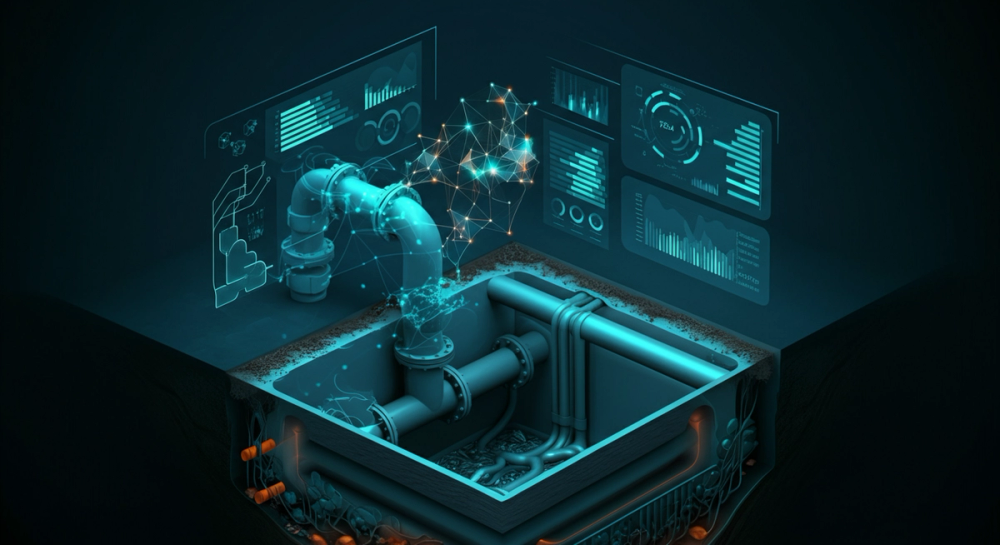
Artificial intelligence is no longer a distant concept reserved for tech giants and science fiction. It is actively reshaping industries — including underground infrastructure. In the Summer 2020 edition of Trenchless International, SewerAI Technical Director Eric Sullivan addresses four essential questions that every underground infrastructure professional should be asking about AI right now.
Question 1: What Is AI and What Terms Do I Need to Know Right Now?
At its core, artificial intelligence is the automation of tasks that involve characteristics of human intelligence — such as recognizing objects or sounds, or performing complex problem-solving and analysis. But to navigate conversations about AI in the infrastructure space, there are a few key terms worth understanding.
Machine learning is a method of training an algorithm so it learns for itself how to fulfill a specific objective. By being exposed to various examples, the algorithm adjusts itself and improves over time — without being explicitly programmed for every scenario.
Deep learning is a subset of machine learning that involves multiple layers of machine learning algorithms forming what is known as a neural network — also referred to as an artificial neural network or convolutional neural network. These layered architectures allow systems to recognize highly complex patterns, making them especially powerful for tasks like image and video analysis.
Question 2: Task Automation or Big Data?
There are two primary areas where AI is making a meaningful difference in underground infrastructure: task automation and big data analytics.
Task Automation
Task automation encompasses applications like the navigation of robotic inspection drones and, most notably, computer vision — the ability of AI to gain a high-level understanding of objects and conditions from digital images or video. In the pipeline inspection world, this means automatically analyzing CCTV footage from sewer and stormwater pipeline inspections.
Several companies have developed computer vision software that automatically recognizes defects and features in pipes and assists in generating condition assessment reports. Compared to traditional manual methods, these AI-driven tools deliver significantly faster turnaround, higher accuracy and consistency, and lower overall cost — a compelling combination for utilities and contractors alike.
Big Data Analytics
On the analytics side, AI assists human decision-makers — asset managers, engineers, and planners — by combing through unmanageable or disparate datasets to extrapolate useful insights, predictions, and descriptions. Applications span a wide range of infrastructure challenges, including:
- Drinking water and wastewater flow monitoring
- Infectious disease tracking (COVID-19 can be detected in sewer discharges)
- Stormwater modelling
- Asset management and rehabilitation planning
A particularly high-value application is risk calculation — combining the likelihood of failure with asset criticality to model risk scenarios. These insights directly drive decision-making in asset rehabilitation and renewal strategies, helping organizations prioritize limited budgets more effectively.
Question 3: Which Type of AI Will Be Most Relevant to Me?
The short answer: AI will most definitely have an impact on you and your work — most likely before the end of this decade. The more useful question is how it will affect your specific role.
Start by examining your work through two lenses. First, identify aspects of your job that involve highly repetitive or rote tasks — these are prime candidates for automation. Second, look at aspects that require critical thinking, interpretation of historical trends, or response to external events — these are where analytics-driven AI is most likely to augment your capabilities.
If your role involves data collection, ask yourself: which tasks are already automated, and which are still performed manually? More importantly, ask why the manual ones haven't been automated yet. The answers often reveal where AI investment will deliver the greatest return.
Question 4: Is AI Inevitable?
Predicting the future is easy. Accurately predicting the future is not. History is full of confident forecasts about transformative technologies — the telephone, the automobile, the television — that turned out to be spectacularly wrong in their timing, scope, or direction.
That said, the pace of AI advancement is difficult to ignore. Stanford's AI Index 2019 reported that the time required to train a neural network on cloud infrastructure for supervised image recognition fell from approximately three hours in October 2017 to just 88 seconds by July 2019. That is not incremental progress — it is a fundamental shift in capability and accessibility.
For underground infrastructure professionals navigating the COVID-19 pandemic, the case for AI becomes even more pressing. US water and wastewater utilities are experiencing unprecedented revenue losses in the tens of billions of dollars, compounded by a wave of retirements and the loss of institutional knowledge. These converging pressures create an urgent demand for solutions that enable organizations to do more with less — and that is precisely the kind of problem AI is built to solve.
This article was originally published in the Summer 2020 edition of Trenchless International. Read the original article.
STAY AHEAD OF THE FLOW
Get SewerAI updates, product news, and practical guidance for modern sewer inspection programs.