The People Who Protect America's Infrastructure Aren't Failing Us. The System Is.
I've spent my career in this industry — and what failed in Washington wasn't the people. It was the system they were handed.
The People Who Protect America’s Infrastructure Aren’t Failing Us. The System Is.
I've spent my career in this industry — and what failed in Washington wasn't the people. It was the system they were handed.
By Billy Gilmartin, Co-Founder & Co-CEO, SewerAI
I grew up understanding that the systems underneath a city are what make it livable. I remember a job early in my career in San Francisco — I was standing inside a pipe with a city inspector who had been doing this work for over 30 years. We were in confined space together, actually inside the pipe, and he was explaining to me, from memory and instinct built over decades, exactly why it had backed up and caused an overflow. No video. No laser report. Just a man who knew this system the way you know your own house. He knew the failure was coming. He'd communicated it internally. But somewhere between his knowledge and the people with the authority to act, the signal got lost.
That moment has never left me. Not because it was unusual — but because it wasn't. I've seen versions of it play out in cities across this country ever since. The knowledge exists. The warnings exist. The people doing this work are among the hardest working, most dedicated professionals you'll ever meet. But the chain between what they know and what gets acted on is broken in ways that cost us every time.
When a reporter from The Atlantic called me earlier this year about the Potomac sewer collapse, I didn't need much context. Unfortunately, I already knew the shape of the story. Here's what I told him:
"If those inspections were uploaded to our platform, they would have been blinking red in terms of risk, as measured by likelihood to fail and consequence of failure."
I stand by that. But I want to explain exactly what I meant — because the full answer is more important than the headline, and it gets to the core of why we built SewerAI in the first place.
The Easy Story Is Wrong
When a major sewer fails, the story almost always gets written the same way: old pipes, deferred maintenance, underfunded utilities, the inevitable bill coming due. That narrative is partially true. Our infrastructure is aging. The maintenance backlog is real. These are serious problems.
But they're not what I was thinking about when I said those inspections would have been blinking red.
What struck me was this: the inspections happened. Multiple of them. According to DC Water in its March 5 report, one survey flagged two holes with the highest structural-risk rating in the system. Another used laser technology to measure corrosion and found segments with nearly six inches of wall loss — in a pipe whose total wall thickness might be six to eight inches. That inspection was "rejected due to poor quality." A subsequent survey didn't cover the same segment. And somewhere in that chain of fragmented, disconnected data, the warnings got lost.
This wasn't a failure of inspection. It was a failure of actionable intelligence — the connected, consistent kind that turns raw survey data into decisions that protect infrastructure and the public that depends on it.
That's the problem we've spent the last seven years building a solution to.
What "Blinking Red" Actually Means
When I said those inspections would have been blinking red in our platform, I was describing something specific about how SewerAI is built.
In our Pioneer platform, inspection data and risk scoring aren't two separate workflows that someone has to manually connect. They're the same workflow. The moment an inspection is processed, it feeds directly into risk assessment — scored by likelihood of failure, consequence of failure, and overall criticality. High-grade findings don't sit in a PDF waiting for an engineer to import them into a spreadsheet somewhere. They surface immediately. They flag. They demand attention.
But that only works if the inspection data going in is accurate and complete. Which brings me to the part of this story that I think doesn't get enough attention.
The Problem Isn't Just Risk Scoring. It's Inspection Quality.
One of the most troubling details in the Washington reporting was this: a laser corrosion survey that found near-catastrophic wall loss was simply rejected. Not corrected. Not escalated for a second look. Rejected.
In most sewer inspection workflows today, that's actually normal. Camera operators work in isolation, coding what they see without standardized feedback loops. When a survey comes back with perceived quality issues, there's no structured process to catch it, correct it, and keep the data alive. It just gets rejected. The pipe gets re-surveyed if someone remembers to schedule it. Or it doesn't.
This is one of the foundational problems AutoCode™ was designed to solve.
Our quality management workflow runs every inspection through three layers of review: AI detection that identifies pipe conditions and flags them as NASSCO observations, NASSCO-certified technician review that validates and finalizes the coding, and a senior QC audit that catches anything the first two layers missed. If an inspection has quality issues, it doesn't get rejected — it gets escalated, corrected, and completed. The data stays in the record.
The result is greater than 98% inspection grade integrity across more than 750,000 NASSCO surveys completed on our platform. It's the metric we hold ourselves to above all others — because if the data isn't accurate, the risk score is wrong. If the risk score is wrong, the rehab plan is wrong. If the rehab plan is wrong, the right pipes don't get fixed. Everything downstream depends on getting this right, and we know it. We track it, audit it, and publish it because our clients need to be able to trust the data they're making decisions from.
Learn more about AutoCode's quality workflow →
A second layer of this is consistency. One of the quiet crises in sewer inspection is that the same pipe, inspected by two different operators, can produce two different assessments. When there's no standardized QC process and no feedback loop to operators, results vary. Findings conflict. The system owner ends up deciding which inspector was right — usually without the analytical infrastructure to make that call confidently.
Our 18 NASSCO-certified technicians, with 175 combined years of experience, review every inspection under consistent standards and are continuously retrained from live QC results. The goal is that you get the same answer regardless of who ran the camera.
What Would Have Happened Differently
I want to be direct about this, because I think it's the most useful thing I can say.
If those inspections had run through our platform, here's what the workflow would have looked like:
The inspections that were "rejected due to poor quality" would not have been rejected. It would have been flagged, escalated to our senior QC team, reviewed, corrected where necessary, and finalized.
That finding, alongside the structural-risk ratings from the earlier survey, would have fed directly into Risk & Rehab. The system would have scored that asset on likelihood of failure and consequence of failure — accounting for pipe age, material, depth, proximity to critical infrastructure, and surrounding land use. It would have been prioritized against every other asset in the system, not evaluated in isolation.
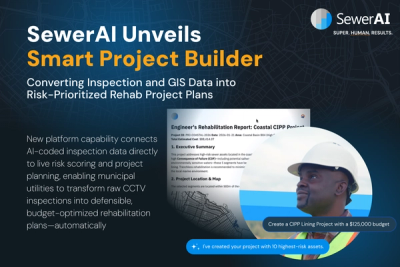
And the result of that prioritization wouldn't have sat in a report. Our Smart Project Builder would have converted it into an actionable rehab plan — with cost estimates, scope definition, and the ability to immediately connect that plan to capital planning and budget cycles.
From inspection to risk score to prioritized rehab plan: one platform, one continuous workflow, no manual handoffs where intelligence can die in transit.
That's what blinking red actually looks like in practice. Not an alert that requires someone to go find it. An actionable signal, in context, connected to what happens next.
Why This Matters Beyond One City
What happened in Washington is not a story about one city's failures. The conditions that led to it — siloed inspection data, inconsistent quality, risk findings disconnected from capital planning — are present in utilities across the country. In cities large and small. In systems newer than Washington's and in systems far older.
We work with data from more than 2,000 cities. I can tell you from direct experience that the fragmented workflow is the industry default, not the exception. The inspection data exists. The warnings are often already in the record. The question is whether the system those utilities are running is built to hear them and act.
The infrastructure crisis in America is real. And it won't be solved by inspections alone, or by any single piece of technology. It will be solved when utilities have access to connected intelligence — where the quality of their inspection data is guaranteed, where risk is scored in real time from verified findings, and where the path from "we found something" to "we're fixing it" is measured in hours, not months or years.
That's the system we're building. And events like this one are a reminder of exactly why it matters.
A Note to Any Utility Reading This
If this story resonated — if you found yourself thinking about your own system, your own data, your own gaps — we'd like to do something concrete to help.
Send us your inspection data and we'll identify your top ten highest-risk assets, with full context on why they scored the way they did. No commitment, no sales process. Just a clear picture of what your data is already telling you — so you can decide what to do with it.
Because the warnings are probably already there. You deserve to know what they are.
Get your free preliminary rehab plan →
Billy Gilmartin is the Co-Founder and Co-CEO of SewerAI, the #1 platform for underground infrastructure management. SewerAI's Pioneer platform has processed more than 100 million feet of pipe video across 2,000+ cities nationwide.

SewerAI Launches Command Center: Turning Inspection Data Into Reports, Maps, and Rehab Plans in Minutes
SewerAI Secures Major Strategic Investment to Accelerate the Future of Underground Infrastructure Management