SewerAI in Trenchless Technology: AI Will Expand Demand for PACP™ Expertise, Not Reduce It
Eric Sullivan, SewerAI's Strategic Development lead and NASSCO-certified PACP™, LACP™, and MACP™ Trainer, authored a sponsored feature in Trenchless Technology's June 2026 Condition Assessment Special Report arguing that AI will expand demand for certified sewer inspection professionals — not reduce it. Drawing on Jevons Paradox, Sullivan contends that when AI removes the binding constraint of human review capacity, inspection programs won't shrink their workforce needs; they'll scale what they attempt. The piece makes the case that PACP™ standards are not displaced by automation — they are the substrate that makes automation worth deploying.
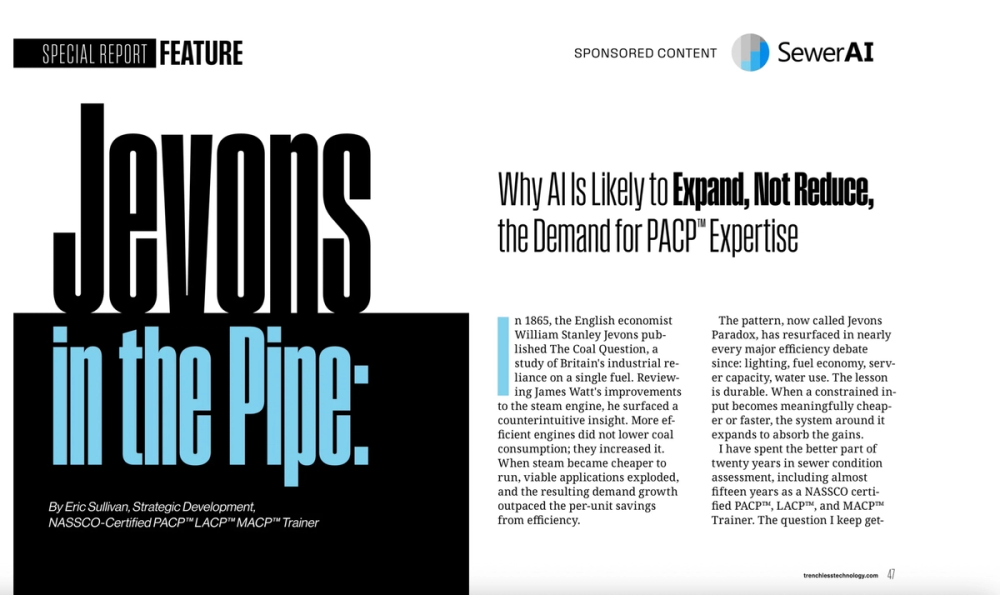
Read the full article in Trenchless Technology’s Condition Assessment Special Report.
Eric Sullivan, SewerAI's Strategic Development lead and NASSCO-certified PACP™, LACP™, and MACP™ Trainer, authored a sponsored feature article in Trenchless Technology's Condition Assessment Special Report (June 2026). In it, Sullivan makes a counterintuitive case: AI-driven automation in sewer condition assessment is not a threat to the PACP™ credential — it is the force most likely to expand demand for it. SewerAI is proud to have supported this contribution to the industry conversation.
The Jevons Paradox, Applied to Sewer Inspection
Sullivan opens with a 19th-century economic observation. In 1865, William Stanley Jevons studied Britain's reliance on coal and found that James Watt's more efficient steam engines did not reduce coal consumption — they increased it. When steam became cheaper to run, viable applications multiplied, and total demand grew faster than per-unit efficiency gains could offset. The pattern, now called Jevons Paradox, has recurred across lighting, fuel economy, server capacity, and water use.
The core insight is durable: when a constrained input becomes meaningfully cheaper or faster, the system around it expands to absorb the gains. Sullivan applies this directly to sewer inspection — and to the question of what AI will do to the professionals who do that work.
The Binding Constraint: Human Review Capacity
Since large-scale CCTV assessment emerged in the 1980s, the bottleneck in sewer condition assessment has been human intellectual throughput. PACP™, introduced in 2002, brought structure and defensibility to a previously fragmented process — but the standard depends on scarce expertise. Training takes time. Certification requires commitment. Consistency across technicians is hard to maintain, and QA/QC is expensive. Review capacity is bounded, in practical terms, by the number of trained eyes a program can put on the work.
That constraint is tightening. The silver tsunami of baby boomer retirements is pulling senior PACP™ practitioners and utility engineering staff out of the workforce faster than replacements can be trained. Meanwhile, the scale of the problem is not shrinking: the US inspects roughly 400 million linear feet of gravity sewer each year against an installed base measured in millions of miles. The gap is not a matter of will. It is a matter of capacity.
AI Changes the Capacity Equation — and Jevons Predicts What Happens Next
Computer vision has fundamentally changed what is possible. Automated defect coding and machine-driven QA enable assessment at speeds no human team can match, flagging inconsistencies that would once have required senior re-review. The natural question is whether this will reduce demand for PACP™-certified professionals. Sullivan argues the Jevons framing points to the opposite conclusion.
When processing costs drop sharply, utilities are unlikely to do the same work with fewer people. They will expand the scope of work. A program reviewing 100 miles per year may scale to 500 or 1,000. Annual snapshot inspections may shift toward something closer to continuous condition intelligence. Analysis that today focuses on primary defects may expand to materials, installation era, geographic clustering, and failure mode interactions. Condition data — underutilized in most capital planning workflows — can move to the center of rehabilitation sequencing, risk scoring, and executive decision support.
As Volume Grows, Governance Becomes More Important
This is the part of the argument that tends to get lost in conversations about automation. A computer vision model can flag a defect candidate. It cannot decide whether a borderline finding aligns with PACP™ coding conventions, or how to weight it given construction era, operational context, or proximity to a force main or critical crossing. As throughput grows, consistency across larger data volumes matters more, not less. When condition data is driving seven- and eight-figure rehabilitation decisions, defensibility is not optional.
Consent decrees, asset management mandates, capacity stress from climate and growth, and the steady aging of collection system infrastructure all pull toward the value of more condition data — and more rigorous governance of that data. The regulatory and operational environment is not pointing toward less inspection. It is pointing toward more.
The Expert’s Role Shifts Upward
The practical effect is that the work of a PACP™-certified professional shifts upward. Time spent watching uneventful footage and chasing clerical inconsistencies declines. Time spent on edge case adjudication, calibration of automated outputs, training data review, and engineering interpretation rises. For most practitioners, that shift represents the highest and best use of the credential — closer to the work the standard was designed to support.
There is also a plausible second-order effect on the certification itself. As automated workflows lower the barrier to running a structured inspection program, more contractors, engineering firms, and smaller utilities can participate. Each of those expansions creates demand for trained personnel who can operate, validate, and sign off on the work. The total population of certified professionals plausibly grows, even as the per-mile labor intensity of any individual program falls.
PACP™ Is the Substrate That Makes Automation Worth Deploying
Sullivan extends the argument to the AI frontier beyond computer vision. Once condition data is structured, normalized, quality-validated, historically contextualized, and geographically grounded, large language models become genuinely useful for infrastructure decision-making in ways earlier analytical tools were not. A utility engineer should be able to ask, in natural language, for a defensible five-year capital rehabilitation plan — with the underlying assumptions and rationale exposed for review and challenge. The only constraint is the quality and structure of the data the model is reasoning over.
PACP™ is not displaced by automation. It is the substrate that makes automation worth deploying. A workflow built on inconsistent or poorly governed coding does not produce better decisions faster — it produces worse decisions faster, at scale, with more confidence than it has earned. The path that avoids that outcome runs directly through standardization.
Read the full article in Trenchless Technology’s Condition Assessment Special Report.